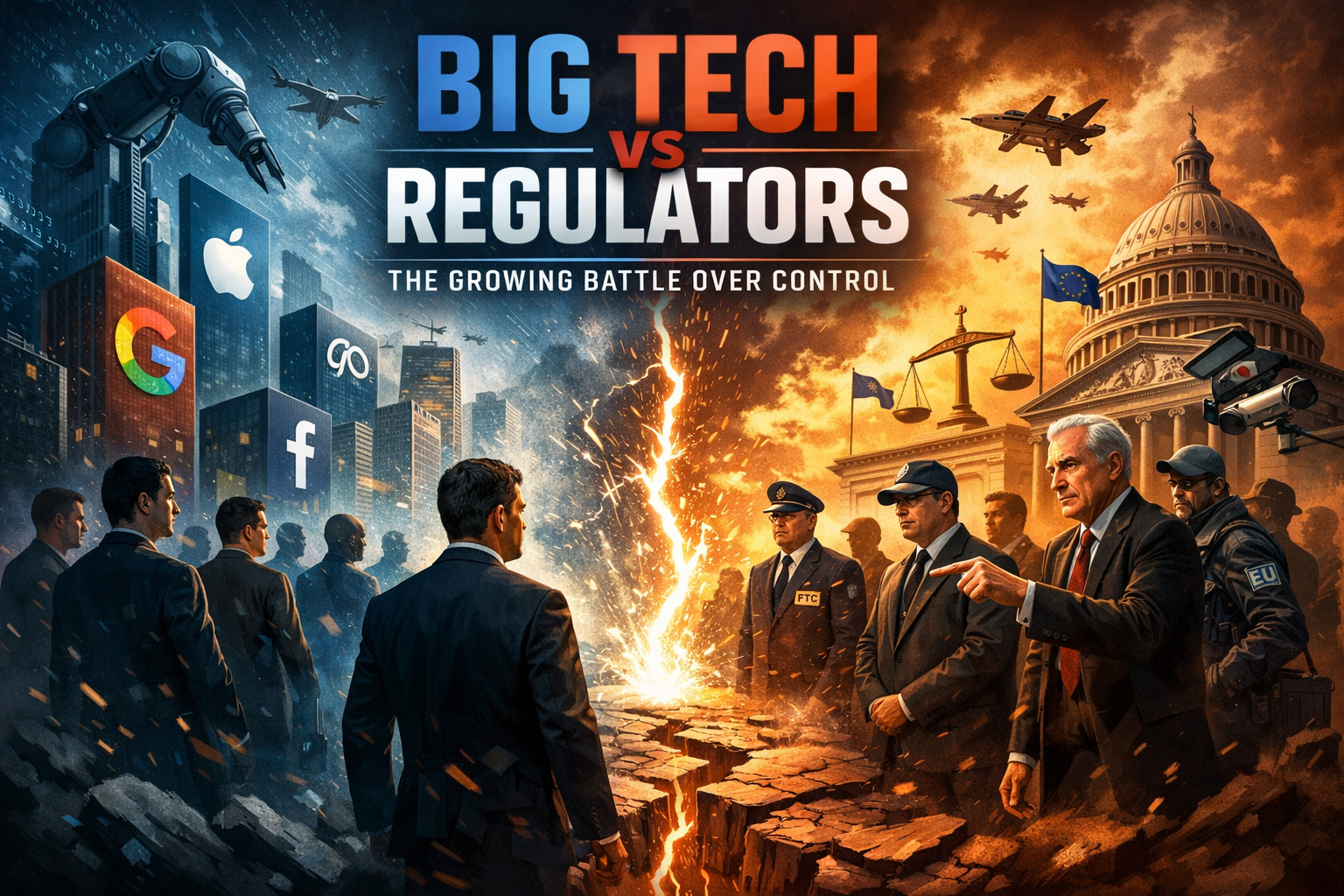
For the better part of two decades, the technology sector operated under a special set of rules. The mantra was simple: move fast and break things. But regulators noticed that what Big Tech was breaking most effectively was the competition.
Today, a tectonic shift is underway. From Brussels to Washington to Beijing, antitrust authorities are no longer just investigating tech giants; they are suing, fining, and restructuring the digital economy. The era of “permissionless innovation” is giving way to the era of “enforcement.”
This is the story of how the world decided that Google, Apple, Meta, and Amazon had become too powerful for their own good—and for the good of the market.
The Old Playbook: Consumer Welfare vs. Digital Dominance
For decades, antitrust law hinged on a simple question: Is the consumer paying higher prices? If a monopoly raised prices, regulators stepped in. If prices stayed low or fell, the assumption was that the market was healthy.
Big Tech mastered this loophole. Google offered free search. Facebook offered a free social network. Amazon offered low prices and fast shipping. To a traditional economist, this looked like a consumer paradise. There was no price-gouging, so there was no crime.
But critics argued that the price of “free” was invisible. You weren’t paying with dollars; you were paying with your data, your attention, and your access to a fair marketplace. The real harm wasn’t to the consumer’s wallet—it was to the competitor trying to get a foot in the door.
The Cases That Changed Everything
The dam broke in the late 2010s, and the flood of litigation has yet to subside.
1. Google’s Search Hegemony (US & EU): The US Department of Justice scored a landmark victory in 2024, proving that Google paid billions of dollars to Apple, Samsung, and Mozilla to be the default search engine on billions of devices. The court ruled that this wasn’t just good business; it was illegal monopolization. Meanwhile, the European Union has levied over €8 billion in fines against Google for abusing its dominance in Android, shopping comparison, and advertising.
2. Apple’s Walled Garden: The fight over the iPhone’s App Store is perhaps the most visceral battle. Epic Games, the maker of Fortnite, argued that Apple’s 30% “tax” on digital transactions was a monopoly rent extracted from developers with no alternative. While courts haven’t called Apple a full monopoly, the pressure forced the company to allow “sideloading” (third-party app stores) in the EU and alternative payment systems in the US.
3. The Meta (Facebook) Identity Crisis: The Federal Trade Commission (FTC) is trying to force Meta to unwind its acquisitions of Instagram and WhatsApp, arguing that Facebook bought its rivals not to improve them, but to neutralize the threat they posed. This strikes at the heart of Silicon Valley’s “acquire or kill” strategy.
4. Amazon’s Dual Role: Regulators accuse Amazon of playing two roles: host and competitor. As the platform owner, Amazon sees every product sale, every click, and every best-seller. Regulators argue it uses this data to launch its own “Amazon Basics” knock-off products, then manipulates search results to bury the original third-party seller.
The Rise of the “Gatekeeper” Theory
The intellectual shift driving these cases is the concept of the gatekeeper.
Modern digital markets are not flat playing fields; they are bottlenecks. Google is the gateway to the web. Apple is the gateway to the iPhone. Amazon is the gateway to e-commerce. If you control the gateway, you control the market.
To address this, the EU introduced the Digital Markets Act (DMA) . Rather than waiting for a ten-year court battle, the DMA pre-emptively lists “dos and don’ts” for gatekeepers. They must allow third-party app stores, they cannot prioritize their own services over rivals, and they must make messaging apps interoperable. It is the most aggressive antitrust regulation since the breakup of Standard Oil.
The Defense: “We Make the Best Products”
The tech giants do not go quietly. Their defense is two-pronged:
First, they argue that their size is a reward for innovation. As Apple puts it, users choose the iPhone because of the secure, curated ecosystem. Forcing the company to open up, they claim, is a subsidy for free-riders like Epic Games.
Second, they point to the speed of technology. While regulators worry about Google’s search monopoly, the market has already pivoted to AI. Google is now fighting for relevance against ChatGPT and Perplexity. By the time a court orders a breakup, the argument goes, the monopoly may already be obsolete.
The Unintended Consequences
For all the applause from small businesses and consumer advocates, there is anxiety about the cure.
If the US and EU break up Big Tech, will they inadvertently hand the advantage to Chinese giants like Tencent, Alibaba, and ByteDance (TikTok), which face no such regulatory constraints? Furthermore, if Apple is forced to allow any app into the iPhone, will the “security” that millions of users rely on vanish, leading to an explosion of malware?
Antitrust enforcers believe these are manageable risks. But history suggests that breaking up a monopoly is a blunt instrument. The breakup of AT&T in 1984 led to the rise of the modern telecom industry, but it also took 20 years to fully play out.
The Bottom Line
We are living through the most significant antitrust moment in a generation. The legal battles against Big Tech will likely drag through the rest of the decade, climbing the ladder to the Supreme Court and the European Court of Justice.
But the political battle is already over. The consensus has changed. The old belief that technology companies are inherently good, inherently disruptive, and inherently immune to the laws of market power is dead.