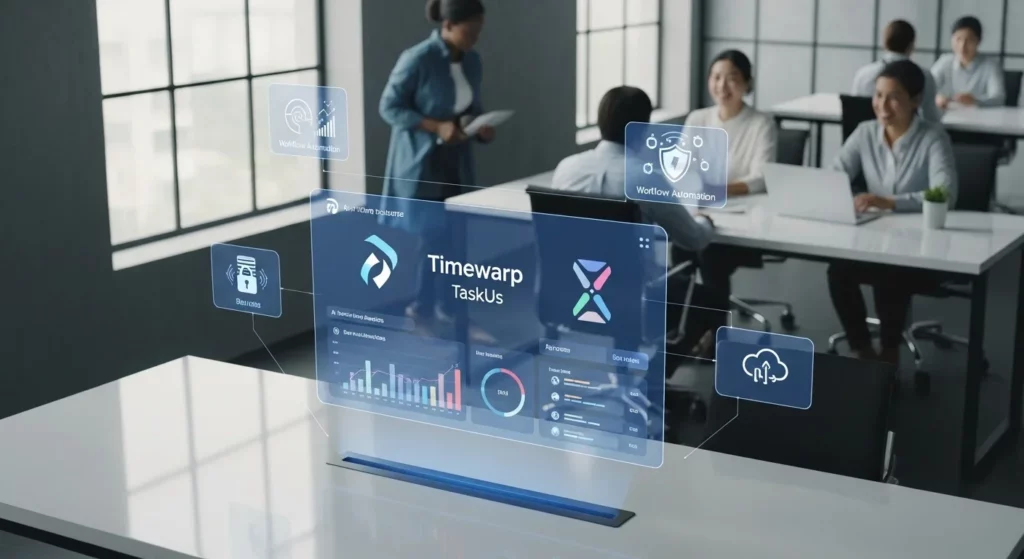
In today’s fast-moving digital work environment, companies rely heavily on smart systems to manage employees, track productivity, and streamline operations. One such concept often associated with modern workforce management is Timewarp TaskUs, a term that reflects advanced time tracking and scheduling practices used in large-scale outsourcing and customer support environments.
Although it may sound technical at first, the idea behind it is simple: making work hours more transparent, efficient, and data-driven so teams can perform better without unnecessary confusion or manual tracking.
Let’s break it down in a practical, human way.
What is Timewarp TaskUs?
Timewarp TaskUs generally refers to a structured workforce management approach associated with TaskUs-style operations, where employee time, attendance, and productivity are tracked using digital systems instead of manual logs.
It is designed to help organizations:
- Monitor employee working hours accurately
- Reduce time theft or scheduling errors
- Improve shift planning and workforce allocation
- Support remote and hybrid team structures
- Increase transparency in performance tracking
In simple terms, it’s a smarter way of handling time data so companies can focus more on output rather than administrative tracking issues.
How It Works in Real Work Environments
The system behind Timewarp-style workforce tools typically works through automated logging and integrated dashboards. Employees clock in digitally, shifts are assigned in advance, and managers can view real-time updates about attendance and productivity.
Most systems include:
- Digital clock-in/clock-out tools
- Shift scheduling dashboards
- Automated overtime calculation
- Attendance analytics
- Performance tracking integration
Instead of manually checking spreadsheets, everything is updated instantly, reducing errors and improving decision-making.
Key Features That Make It Effective
What makes this approach powerful is not just time tracking, but how deeply it integrates with workforce optimization.
Some standout features include:
- Real-time attendance monitoring
- Shift automation and scheduling flexibility
- Performance-based reporting tools
- Cloud-based access for remote teams
- Error reduction through automation
These features help managers understand exactly how time is being used across teams and departments.
Industry Use Case and Practical Example
Imagine a global customer support team handling thousands of queries daily. Agents are working across different time zones, and manual scheduling starts creating confusion—some shifts overlap, others are understaffed, and payroll discrepancies start appearing.
Now, a Timewarp-style system is introduced. Shifts are automatically assigned based on availability, attendance is tracked digitally, and managers can instantly see who is active, idle, or offline.
Within weeks, response times improve, employee frustration reduces, and the entire operation becomes smoother and more predictable.
Personal Experience Insight
I once noticed in a mid-sized support setup how switching from manual spreadsheets to an automated time tracking system drastically reduced payroll disputes and improved shift clarity almost overnight.
Comparison: Traditional Tracking vs Timewarp Approach
To better understand its value, here’s a simple comparison:
| Feature | Traditional Time Tracking | Timewarp-Style System |
|---|---|---|
| Attendance Recording | Manual entries or spreadsheets | Automated digital logging |
| Error Rate | High due to human input | Low due to automation |
| Shift Scheduling | Time-consuming and static | Dynamic and flexible |
| Remote Workforce Support | Limited | Fully optimized |
| Reporting | Delayed and manual | Real-time analytics |
| Productivity Insights | Basic | Advanced and data-driven |
This comparison clearly shows how modern systems outperform older methods in almost every operational area.
Why Businesses Use Timewarp Systems
Organizations adopt these systems not just for convenience but for strategic advantages.
Key benefits include:
- Improved workforce transparency
- Better resource allocation
- Reduced administrative workload
- Accurate payroll processing
- Enhanced employee accountability
- Faster decision-making through analytics
When time data becomes reliable, every other business decision becomes more accurate.
Challenges and Considerations
Despite its benefits, implementing such systems is not always smooth. Some challenges include:
- Employee adaptation to new tools
- Initial setup and training requirements
- Dependence on internet connectivity
- Privacy and monitoring concerns
However, most of these challenges can be managed with proper onboarding and clear communication.
Best Practices for Effective Use
To get the most out of a Timewarp-style workforce system, companies often follow these practices:
- Train employees before full rollout
- Keep scheduling rules transparent
- Regularly audit time reports
- Combine automation with human oversight
- Encourage feedback from team members
This ensures the system supports people rather than overwhelming them.
The Bigger Picture: Why It Matters
At its core, Timewarp TaskUs represents a shift in how modern workplaces think about time. Instead of treating time as just hours on a clock, it becomes a measurable asset that directly connects to performance, efficiency, and business growth.
For remote teams, outsourcing companies, and global operations, this kind of system is no longer optional—it’s essential.
Also Read: ARCarrierPoint Net Guide: Results & Updates Portal
Conclusion
Time management has evolved far beyond manual tracking and spreadsheets. With systems like Timewarp TaskUs-style solutions, businesses gain a clearer, faster, and more accurate way to manage their workforce.
From real-time monitoring to intelligent scheduling, it transforms chaotic workflows into structured, efficient operations. While it requires adjustment and proper implementation, the long-term benefits far outweigh the challenges.
In a world where productivity defines success, smarter time systems are not just helpful—they’re necessary.
FAQs
1. What is Timewarp TaskUs used for?
It is used for managing employee time, attendance, and shift scheduling in a more automated and efficient way.
2. Is Timewarp TaskUs a software or concept?
It is generally understood as a workforce management approach linked to digital time tracking systems used in large organizations.
3. Can it be used for remote teams?
Yes, it is especially useful for remote and hybrid teams because it offers real-time tracking and cloud-based access.
4. What are the main benefits of this system?
It improves accuracy, reduces manual work, enhances productivity, and provides real-time workforce insights.
5. Does it replace managers?
No, it supports managers by giving them better data, but human decision-making is still essential.